Essential Bakery Equipment for New Bakery | AK Sales
In short
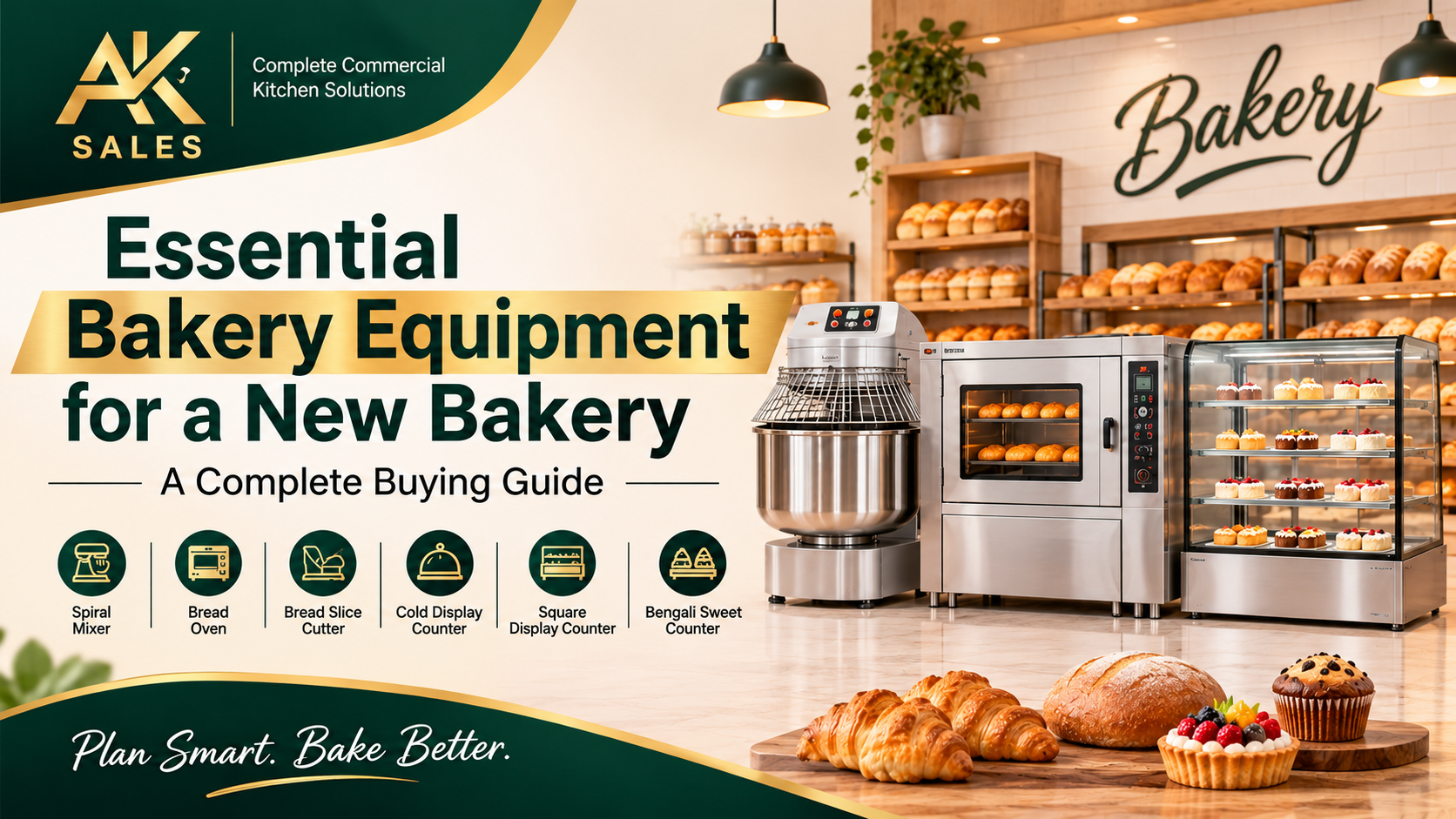
essential commercial bakery equipment for setting up a new bakery. Learn about spiral mixers, bread ovens, bread slice cutters and display counters to choose the right machines for your business.
Most new bakery owners spend their budget badly. They buy an oven but then they notice that the bread takes too long to slice and pack the dough is uneven or the display counter cannot keep the right temperature.
Choosing the commercial bakery equipment by looking at your menu how much you want to make and how much room you have is the first step to set up a successful bakery.
This guide explains what six key bakery machines do how to pick the size and what to check before you buy.
Start with the Menu for Your Bakery of the Equipment Catalogue
Product Selection for Bakery
Product Selection for Bakery | Equipment of Priority |
Rolls, buns and bread | Bread slice cutter, bread oven and spiral mixer |
Pastries and cakes | Refrigeration, oven and cold display counter |
Mithai and sweets | Square display counter and Bengali sweet counter |
A variety of baked goods | Display counters, oven and mixer |
Estimate your expected output too. Find out how loaves, cakes, pastries and sweet boxes you want to make. These numbers will help you pick the right equipment size.
A Quick Look at the Essential Bakery Equipment List
Here is a summary of the key pieces of equipment used in commercial bakeries before we look at each machine in detail.
Equipment | Principal Goal | Priority |
Spiral Blender | Mixing and preparing the dough | A necessity for bread |
Bread Oven | Making bread, buns and goods | Crucial |
Cutter for Bread Slices | Cutting uniform slices of bread | For bread slices |
Counter with a Cold Display | Presenting chilled pastries and cakes | Regarding cakes |
Counter with Square Display | Putting bread, cookies and dry goods on display | For retail |
Sweet Counter in Bengali | Putting mithai and candies on display | For confectionery stores |
Spiral Mixer: The Source of Good Dough
How bread rises, bakes and tastes depends on the quality of the dough. Therefore proper mixing is one of the important steps in making baked goods.
A spiral mixer uses a hook and a revolving bowl to mix dough evenly. Bread, buns, rolls and other dense dough products get a lot of help from it.
While cutting down on labour and preparation time a commercial spiral mixer helps keep dough quality the same.
How to Pick the Best Spiral Mixer
Bowl capacity: Pick a mixer that can hold the size of your batch of regular dough.
Production capacity: Do not run the machine at capacity all the time.
Control settings: Check the safety guards, timers and speed settings.
Build quality: Look for a mixer built with food-grade steel.
Cleaning: Choose a design that's easy to maintain and clean.
Planetary vs. Spiral Mixers
Bread dough and other heavy mixtures are the uses for spiral mixers. For mixtures, creams and cake batters a planetary mixer is more adaptable.
A spiral mixer is usually a choice if your main products are bread, buns and rolls. Bakeries that specialise in cakes might need both machines or a planetary mixer.
The Bread Oven: The Center of Bakery Production
How much your bakery can make in a set amount of time depends on the oven. Bread, buns and other baked goods can be baked with even heat using a bread oven.
Because a small oven can slow production during busy hours choosing the right oven size is crucial.
How to Determine the Appropriate Oven Capacity
Take these steps:
Calculate how many baked goods you will need during busy times.
Determine how many items can fit on one baking tray.
Divide the number of goods, per tray by the production need.
Determine how baking cycles you can run during your working hours.
Choose an oven that has capacity to meet your production needs.
Crucial Elements to Verify Before Purchasing
Distribution of heat: Make sure the oven bakes evenly.
Temperature control: Look for user-friendly temperature settings.
Insulation: Good insulation lowers operating costs and heat loss.
Fuel needs: Verify whether the ovens gas or electrical needs can be met on your property.
After-sales care: Verify whether replacement parts and technical assistance are available.
Bread Slice Cutter: Packaging and Consistent Slices
A bread slice cutter is a device for bakeries that sell packaged loaves and sandwich bread.
It speeds up packaging enhances presentation and cuts bread into slices.
Things to Look for Before Purchasing
Durability and quality of the blade.
Operating features and safety precautions.
Cleaning and crumb removal are simple.
Suitability for the sizes of your bread loaves.
Uniform thickness of slicing.
Advice: Before slicing bread always let it cool completely. When cutting warm bread may. Become compressed.
When demand rises you can add a bread slicer if your bakery primarily sells loaves, buns or pastries.
Cold Display Counter: Preserve the Freshness of Cakes and Pastries
To preserve their freshness and quality cream cakes, pastries and desserts need to be chilled.
A cold display counter uses glass panels to present goods in an appealing manner while offering refrigerated storage.
Features to Take Into Account
Uniform cooling on every shelf.
Transparent fog-resistant glass.
Lighting that's appropriate for product visibility.
Appropriate shelf spacing for pastry trays and cakes.
Interiors are simple to clean.
Adequate drainage to avoid water buildup.
Product visibility may be diminished by condensation. This problem can be reduced by sealing the counter and placing it away from heat sources and direct sunlight.
Square Display Counter: The Perfect Option for Regular Bakery Items
Not all baked goods need to be refrigerated.
A square display counter can be used to showcase bread, cookies, rusks, savoury snacks and packaged bakery goods.
It offers a neat, well-organised and user-friendly display space.
Combining a square display counter with a cold display counter is a solution for bakeries that sell both bread and cakes. It enables you to keep chilled and non-refrigerated goods
Bengali Sweet Counter: Hygienically Display Mithai and Sweets
Mithai and other traditional Indian sweets are also sold in contemporary bakeries.
The purpose of a Bengali counter is to present candies in an eye-catching manner while maintaining their organization and accessibility for serving.
Things to Look for Before Purchasing
Glass visibility is clear.
Access to products.
Surfaces that're simple to clean.
Appropriate product placement.
A suitable area to display types of sweets.
The presentation of products and the general customer experience can both be enhanced by an well-maintained sweet counter.
You can add this equipment later if your bakery does not sell sweets.
Which Bakery Equipment Is Best to Purchase First?
Before starting your bakery you do not have to buy every machine. You can better manage your investment by using a phased purchasing strategy.
Phase 1: Pre-opening Essential Equipment
Mixer for making dough.
Use a bread oven for baking.
One display counter that works well for your menu.
Phase 2: Growing Production Equipment
For packaged bread a bread slice cutter.
An extra display counter.
Refrigeration if necessary.
Phase 3: Growth and Enhanced Output
Oven or more space for baking.
If you introduce sweets there will be a Bengali counter.
Extra equipment in response to consumer demand.
Prior to purchasing equipment keep an eye on daily sales and production needs.
How to Assess the Quality and Construction of Bakery Equipment
Equipment for bakeries is a long-term investment. Selecting equipment on the basis of its purchase price may result in increased maintenance and replacement expenses.
Before making a purchase take into account these crucial factors:
Quality of Material
Verify the equipments grade of stainless steel. Because of its resistance to corrosion food-grade steel like SS 304 is frequently chosen.
Welding
A professional finish, rounded edges and smooth welding are what you should look for. Equipment is easier to maintain and clean thanks to these features.
Service and Spare Parts
Find out about repair schedules, maintenance assistance and the availability of parts.
Options for Customisation
Verify if equipment dimensions can be altered to fit your bakerys layout and available space.
Guarantee
Make sure you know what is covered and always ask for written warranty terms.
Typical Errors to Avoid When Purchasing Bakery Supplies
Steer clear of these blunders when starting a new bakery:
Purchasing equipment without designing the layout: Ensure there is space for staff to move, for cleaning and for machine operation by measuring your area.
Selecting an oven on the basis of cost: Poor heat distribution can lead to lower quality products and longer production times.
Choosing the capacity: Find out your real production needs to avoid mixers that are too big and ovens that are too small.
Disregarding utility requirements: Before placing an order confirm the water, gas and electricity needs.
Ignoring after-sales care: Check that spare parts and technical help are available.
Disregarding the need for hygiene: Choose appliances with surfaces that're easy to clean and made of materials safe for food contact.
Why Purchase Bakery Equipment Straight, from the Manufacturer?
It may be easier to discuss customisation, machine specifications, construction quality and maintenance needs when buying bakery equipment directly from a manufacturer.
Besides making kitchen equipment AK Sales provides commercial kitchen setup and planning services.
Selecting equipment based on your menu available space and production capacity is essential whether you start a bakery or renovate an existing facility.
To find commercial kitchen equipment look through the whole range of bakery products or the AK Sales product line.
Use AK Sales to Plan Your Bakery Setup
Your menu, production capacity, available space and business needs will all affect the equipment you choose for your bakery.
The AK Sales team can help you understand equipment specifications choose machinery and design your commercial kitchen if you build a new bakery or modernise your current setup.
AK Sales
Phone: +91 91067 80688
Address: Near Nayara Petrol Pump, Bhatha, Surat, Gujarat 394510
Frequently asked questions
What equipment do I need to start a bakery?
The core list is a mixer, an oven and display counters. Add a bread slice cutter if you sell sliced bread and a sweet counter if you sell sweets. Hand tools, trays, racks and refrigeration depend on your menu.
Which is the most important machine in a bakery?
For most bakeries it is the oven, because it limits how much you can produce. For bread-focused bakeries, the mixer is close behind because dough quality starts there.
Do I need a spiral mixer or a planetary mixer?
Choose a spiral mixer if bread and dense doughs are your main products. Choose a planetary mixer for cake batters and light mixes. Some bakeries use both.
What is the difference between a cold display counter and a square display counter?
A cold display counter keeps products chilled, so it suits cream cakes and pastries. A square display counter shows ambient items such as breads and cookies.
How do I decide the right oven size?
Work backwards from your daily output. Count the items you need to bake, divide by items per tray, then check how many baking cycles you have available. Add some margin for growth.
Can I start with fewer machines and add more later?
Yes. Begin with the mixer, oven and one display counter, then add the slicer, extra counters and a larger oven as sales grow.